New York Laws Taking Effect This Year: What You Need to Know
Every year, New York changes its laws, and some of those changes are easy to miss. You might notice a different number on your paycheck, see a new rule at a hotel, or discover that something an employer used to ask for is no longer allowed.
2026 is no different.
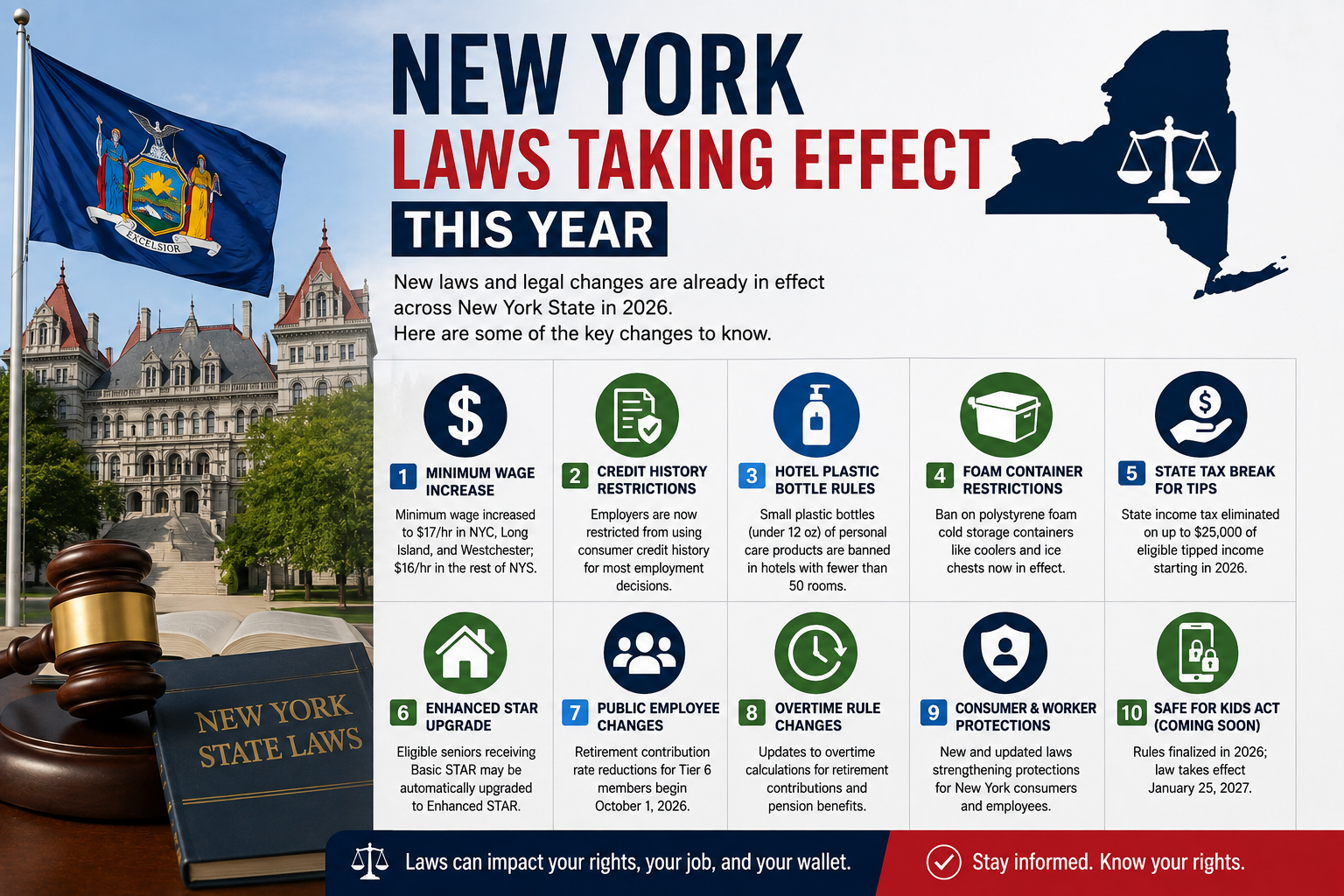
Several new laws and legal changes are already affecting New Yorkers this year, covering everything from wages and employment to taxes, environmental rules, and consumer protections. Some affect almost everyone, while others apply only to certain workers, businesses, or situations.
Here are some of the changes worth knowing about.
New York’s Minimum Wage Increased
One of the changes most people will notice is the increase in New York’s minimum wage.
Beginning January 1, 2026, the minimum wage increased to $17 per hour in New York City, Long Island, and Westchester County. In the rest of New York State, it increased to $16 per hour. (ny.gov)
For tipped workers, different wage rules can apply depending on the industry and location.
This matters not only to employees. Businesses also have to make sure their payroll practices comply with the updated rates. New York can impose penalties and other consequences when employers fail to pay the required minimum wage. (ag.ny.gov)
New Rules on Using Credit History for Employment
Another important change concerns job applicants and employees.
New York law now places significant restrictions on employers’ ability to request or use a person’s consumer credit history for employment decisions. The law covers information such as credit reports, credit scores, payment history, and certain information about debts, collections, bankruptcies, judgments, and liens. (nysenate.gov)
The law does have exceptions. For example, certain law-enforcement positions and positions subject to particular background-investigation requirements can be treated differently.
For an ordinary job applicant, however, a poor credit history is no longer something an employer can simply use as a routine hiring consideration.
Some Hotel Plastic Bottles Are Now Restricted
This is one of those changes you might notice without realizing that a law is behind it.
New York expanded its restrictions on small plastic bottles containing personal-care products at hotels, motels, apartment hotels, and boarding houses.
Beginning in 2026, the restriction applies to properties with fewer than 50 rooms. Covered properties generally cannot provide small plastic bottles containing less than 12 ounces of personal-care products such as shampoo, conditioner, moisturizer, or body wash. (dec.ny.gov)
So if you stay at a smaller New York hotel and notice larger refillable containers instead of the little shampoo bottles people have become used to, there’s a reason for it.
New Restrictions on Certain Foam Containers
New York also expanded its polystyrene foam restrictions in 2026.
Beginning January 1, certain expanded polystyrene foam containers designed for cold storage, including products such as coolers and ice chests, became subject to the state’s ban. The rules apply to covered businesses, manufacturers, and stores, with certain exemptions. (dec.ny.gov)
New York has already restricted many disposable foam food-service containers and packing peanuts. The 2026 change extends the restrictions to additional cold-storage products.
One important detail: New York City’s rules can differ because the city has its own local polystyrene restrictions.
New York Is Providing a State Tax Break for Certain Tips
The state’s 2026 budget also includes a tax change affecting tipped workers.
New York is eliminating state income tax on up to $25,000 of eligible tipped income beginning with the 2026 tax year. The change is intended to put more money back into the pockets of workers who receive qualifying tips. (nysenate.gov)
This doesn’t mean every dollar described as a tip is automatically tax-free. Eligibility and the types of income that qualify still matter.
So if you work in a tipped occupation, it is worth paying attention to how the new deduction applies when you file your taxes.
Some Seniors Can Receive an Automatic Enhanced STAR Upgrade
There is also a property-tax-related change that may be helpful for eligible older homeowners.
Under a 2026 law, certain seniors who already receive the Basic STAR exemption can be automatically upgraded to the Enhanced STAR exemption without having to submit a new application to their local assessor. (assembly.ny.gov)
For someone who has dealt with property-tax paperwork before, not having to submit another application can be a welcome change.
The automatic process applies only to people who meet the requirements, so homeowners shouldn’t assume the upgrade applies to everyone receiving STAR.
Changes Affecting Public Employees and Retirement Benefits
Some 2026 changes are more specific and mainly affect public employees.
For example, New York’s 2026-27 budget includes reforms affecting Tier 6 members of the New York State and Local Retirement System. Contribution rates for many Tier 6 members are being reduced based on earnings, with the new rates taking effect October 1, 2026. (osc.ny.gov)
The budget also changes certain overtime rules used when calculating retirement contributions and pension benefits.
These changes won’t affect every New Yorker, but for public employees, they can have a direct impact on take-home pay and retirement planning.
What About the SAFE for Kids Act?
This is worth mentioning because it has received a lot of attention in 2026, but there is an important distinction.
New York released final rules for the SAFE for Kids Act in July 2026. The law is designed to restrict certain addictive social-media features for users under 18, including personalized addictive feeds and nighttime notifications, unless the required parental consent is obtained. (ag.ny.gov)
However, the SAFE for Kids Act itself does not take effect until January 25, 2027.
So it is a major New York legal development this year, but it shouldn’t be described as a law already in effect in 2026. (ag.ny.gov)
Why These Changes Matter
The interesting thing about new laws is that they don’t always feel like “new laws.”
For an employee, it might simply mean a larger paycheck because of the minimum wage increase.
For a job applicant, it could mean an employer can’t rely on certain credit information when making a hiring decision.
For a hotel owner, it means changing the products offered to guests.
For a tipped worker, it could affect the way income is treated when filing a state tax return.
And for parents, the upcoming social-media rules could eventually change how children interact with certain online platforms.
That is why keeping track of New York law isn’t only something lawyers and businesses need to worry about.
Frequently Asked Questions (FAQs)
What new laws took effect in New York in 2026?
Several legal changes took effect during 2026, including the higher minimum wage, expanded restrictions on certain plastic hotel bottles and foam cold-storage containers, restrictions on the use of consumer credit history for employment decisions, and other tax and public-benefit changes.
Did New York’s minimum wage increase in 2026?
Yes. The minimum wage increased to $17 per hour in New York City, Long Island, and Westchester County and to $16 per hour in the rest of New York State beginning January 1, 2026. (ny.gov)
Can New York employers still check an applicant’s credit?
New York law now significantly restricts employers from requesting or using consumer credit history for employment purposes, although certain exceptions apply, including some law-enforcement and legally required background-investigation positions. (nysenate.gov)
Is the SAFE for Kids Act already in effect?
No. Although New York finalized the implementing rules in 2026, the SAFE for Kids Act is scheduled to take effect January 25, 2027. The law will restrict certain addictive social-media features for users under 18, subject to its requirements and exceptions. (ag.ny.gov)
Final Thoughts
New York’s 2026 legal changes cover a surprisingly wide range of everyday situations.
Some are easy to notice, like the higher minimum wage. Others are happening quietly in the background, such as restrictions on how employers can use credit information or changes affecting retirement contributions and property-tax benefits.
And then there are laws that have been passed or finalized but won’t actually take effect until later. That’s an important distinction because seeing a headline about a new law doesn’t necessarily mean the rule applies immediately.
If a particular change affects your job, business, taxes, property, or legal rights, it is worth checking the current version of the law rather than relying on an old article or social-media post. New York’s rules can also differ between state and New York City law, so the location and circumstances can matter.