
Bringing a child home from the hospital is one of those moments you never really forget. For many parents, it’s also the first time they realize just how many rules there are about car seats. Then, as children grow, the questions keep coming. Is it time for a booster seat? Can they sit in the front? Have they outgrown their current car seat?
If you live in New York or are planning to travel there with children, understanding the state’s car seat laws is more than just following the rules. It’s about giving your child the best possible protection every time you get behind the wheel. Here’s what you should know.
Why New York Has Car Seat Laws
Children are not simply smaller versions of adults. Their bodies develop differently, and regular seat belts are designed for fully grown passengers. A seat belt that fits an adult properly may not protect a young child during a crash.
That’s why New York requires children to ride in age- and size-appropriate child restraint systems. The goal isn’t to make life more complicated for parents. It’s to reduce the risk of serious injury if an accident happens.
What Does New York Law Require?
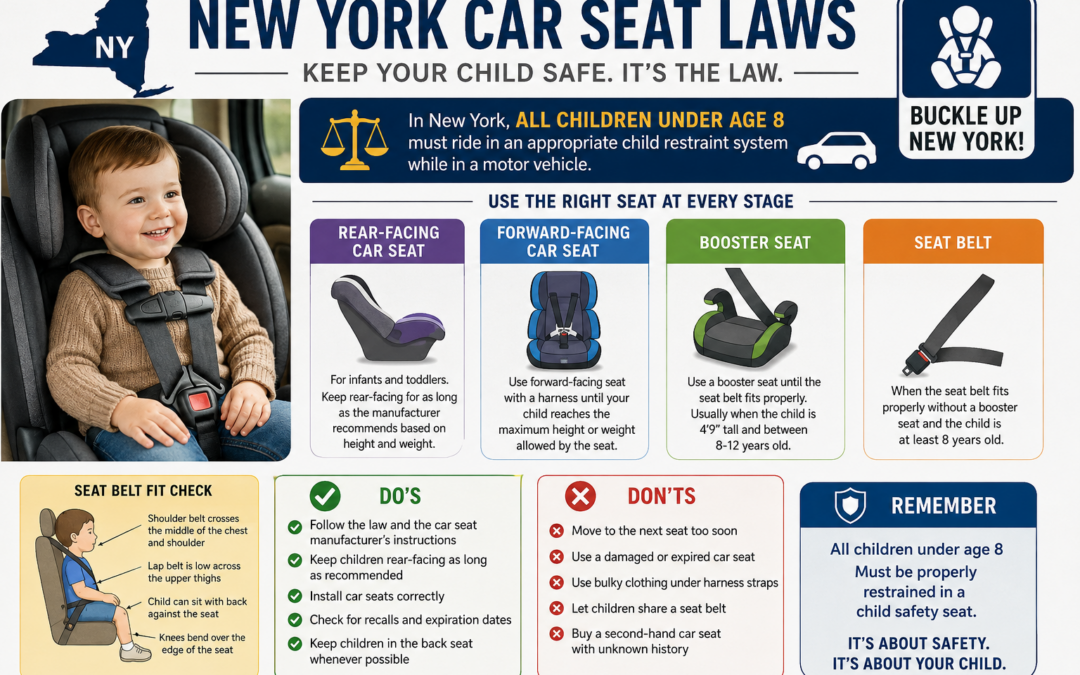
New York law requires all children under the age of 8 to ride in an appropriate child restraint system while traveling in a motor vehicle.
The type of restraint depends on the child’s age, height, weight, and the manufacturer’s recommendations for the car seat being used.
Children who are 8 years old or older must use either a properly fitted seat belt or an appropriate child restraint system if the seat belt alone does not fit correctly.
Rear-Facing Car Seats
Rear-facing car seats are generally the safest option for infants and young toddlers.
They are designed to support a child’s head, neck, and spine during a collision, distributing crash forces more evenly across the body.
Parents should keep children in a rear-facing seat for as long as the car seat manufacturer allows based on the child’s height and weight limits.
Many children remain rear-facing well beyond their first birthday.
Forward-Facing Car Seats
As children grow, they eventually reach the height or weight limit for their rear-facing seat.
At that point, they usually transition to a forward-facing car seat equipped with a five-point harness.
The harness helps keep children securely positioned while reducing movement during sudden stops or collisions.
Again, parents should follow the manufacturer’s height and weight recommendations before making the switch.
When Is It Time for a Booster Seat?
A booster seat becomes appropriate after a child has outgrown a forward-facing harness seat but is still too small for an adult seat belt to fit correctly.
The purpose of a booster seat is simple.
It raises the child so the vehicle’s seat belt rests properly across the strongest parts of the body instead of the stomach or neck.
Moving out of a booster too early can reduce the effectiveness of the seat belt in a crash.
When Can a Child Use Only a Seat Belt?
Many parents assume this happens once a child reaches a certain birthday, but that’s not always true.
A child is ready to use a seat belt alone only when it fits properly without assistance.
A proper seat belt fit generally means:
- The lap belt rests across the upper thighs, not the stomach.
- The shoulder belt crosses the middle of the chest and shoulder.
- The child can sit with their back against the vehicle seat.
- Their knees bend naturally over the edge of the seat without slouching.
If the seat belt doesn’t fit this way, a booster seat may still be the safer option, even for older children.
Should Children Ride in the Front Seat?
Although New York law allows some older children to ride in the front seat under certain circumstances, safety experts generally recommend keeping children in the back seat whenever possible.
The back seat is typically considered the safest place for children because it reduces the risk of injury from front airbags during a collision.
If a child must ride in the front seat, the vehicle seat should be moved as far back as possible, and the seat belt should fit properly.
Common Car Seat Mistakes Parents Make
Even parents who carefully follow the law sometimes make simple mistakes.
Some of the most common include:
- Switching to the next type of seat too soon.
- Installing the car seat incorrectly.
- Leaving harness straps too loose.
- Using a seat that has expired.
- Buying a second-hand car seat with an unknown history.
- Forgetting to register a new car seat for safety recalls.
Taking a few extra minutes to double-check installation can make a significant difference in a crash.
Do’s and Don’ts of New York Car Seat Safety
Do:
- Choose a car seat that matches your child’s height and weight.
- Follow both New York law and the manufacturer’s instructions.
- Keep children rear-facing as long as recommended.
- Use the harness correctly every trip.
- Check your car seat regularly for recalls or expiration dates.
Don’t:
- Move to a booster seat too early.
- Let children share a seat belt.
- Use damaged or expired car seats.
- Place bulky winter coats under harness straps.
- Assume age alone determines when a child is ready for the next seat.
Why These Laws Matter
It’s easy to think, “We’re only driving a few minutes.”
The truth is, many accidents happen close to home during everyday trips. A properly installed car seat can’t prevent every injury, but it greatly improves a child’s chances of staying safe in a crash.
That’s why New York’s car seat laws focus not just on age but also on using the right restraint for each stage of a child’s growth.
Frequently Asked Questions (FAQs)
At what age does a child no longer need a car seat in New York?
Under New York law, children under 8 years old must ride in an appropriate child restraint system. After that, they may use a seat belt if it fits properly, although some children may still benefit from using a booster seat.
Can my child sit in the front seat in New York?
The law does not completely prohibit older children from sitting in the front seat, but the back seat is generally considered the safest place for children whenever possible.
Are booster seats required in New York?
Yes, if a child has outgrown a forward-facing car seat but is still under 8 years old or the vehicle’s seat belt does not fit properly, an appropriate booster seat may be required.
What happens if I don’t follow New York’s car seat laws?
Violating New York’s child restraint laws can result in fines, points on your driving record, and other legal consequences. More importantly, failing to use the proper car seat can significantly increase the risk of injury during a crash.
Final Thoughts
New York’s car seat laws exist for one simple reason: to help keep children safe every time they travel. While remembering every rule can seem overwhelming at first, the basic idea is straightforward—use the right child restraint system for your child’s age, height, and weight, and don’t rush to move them into the next stage before they’re ready.
As children grow, it’s worth checking both the law and your car seat manufacturer’s recommendations from time to time. A few small adjustments today can make a big difference if the unexpected ever happens on the road.